

How to Read a Racecard Without Getting Lost in the Numbers
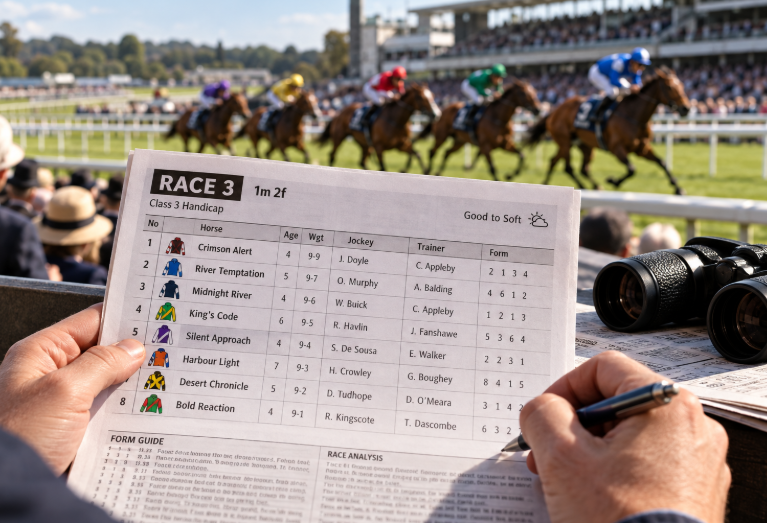
At first glance, a racecard resembles a very small spreadsheet with a surprisingly large amount to say. Names sit beside figures, abbreviations and weights, all competing for attention. A new reader does not need to decode every box. A few recurring details reveal most of what matters before the race begins.
Start With the Horse, Then Read Outwards
Begin with the horse’s name, race number, age, jockey and trainer. After that, move to recent form and the conditions of today’s race. The jockey’s silks help too, especially once several runners bunch together and identifying a horse by name becomes impossible from the stands.
A racecard stays firmly rooted in racing even if someone reaches it through a website that also contains a casino section or other entertainment. The useful part is much narrower. It tells the reader who is running, what each horse carries and what happened in its most recent starts.
A simple first pass can follow four steps:
- Locate the latest runs and see whether the horse has been finishing close to the front.
- Check the assigned weight if the race is a handicap.
- Take note of the jockey and trainer.
- Scan the card for clues about previous success at the same course or distance.
That is enough for a first reading. No need to interrogate every number like it owes money.
Recent Form Works Like a Compact Timeline
The form sequence records recent finishing positions, with the newest result appearing at the right hand end. Figures from 1 through 9 correspond to those finishing places. A 0 tells the reader that the runner finished tenth or worse, while jump racing may also use letters for outcomes such as falling or being pulled up.
Take a line ending 4612. Reading from the right, the latest run produced second place, the previous one a win, then sixth and fourth. The sequence does not forecast the next result. It simply compresses several races into a few characters, which is far quicker than opening each result separately.
Racecards often add short markers for previous achievements. C identifies a horse that has won at the course, D refers to a victory over the same distance, and CD combines both. BF has another meaning, showing that the horse went off as favourite on its previous start and failed to win.
Those letters become more useful once the reader puts them beside today’s conditions. Someone comparing the racecard with prices shown by 1xbet may see recent results reflected in the market, but a neat form line can hide important differences in distance, surface and race quality. Context still wins.
Handicap Weight Needs a Different Reading
The weight printed beside a runner does not describe the animal’s actual body mass. It shows the racing weight that must be carried, traditionally written in stones and pounds in Britain. That total includes the jockey and the relevant equipment.
Handicaps create another layer. The British Horseracing Authority gives eligible horses official ratings, and the race conditions translate those ratings into different carrying weights. In broad terms, the horse with the stronger rating receives the greater burden relative to lower rated rivals in the same contest.
Readers can make the column easier to use by checking three things:
- Compare today’s assigned weight with the runner’s official rating.
- Look back at recent races and see how the horse performed from a similar handicap mark.
- Notice whether today’s burden differs meaningfully from the last start.
A higher weight does not automatically condemn a runner. A lower one does not produce a free win either. If racing worked that neatly, racecourses would need far fewer bookmakers.
Course, Distance and Ground Add the Missing Context
Recent results become more informative once the reader asks where and how they happened. A horse might arrive after several strong finishes yet face a very different test today, perhaps a longer trip, softer ground or a track with a completely different shape.
Course and distance indicators give a quick clue about experience. A CD beside a horse’s name confirms previous success over the same track and trip, but it says nothing about whether today’s field, pace or ground will resemble that earlier race. Useful evidence, yes. A guarantee, no.
Ground conditions deserve similar attention. British turf cards use descriptions such as firm, good, soft and heavy, along with intermediate combinations. A runner with plenty of past races may show a clear preference, while a lightly raced horse can leave much more room for uncertainty.
Before the start, a reader can therefore build a compact picture:
- Recent finishes show what the horse has been doing.
- Course and distance records reveal whether today’s setup is familiar.
- Weight adds context in handicaps.
- Ground can explain why an apparently similar race may demand something different.
Four checks usually tell a clearer story than twenty isolated numbers.
Read the Card in Layers
Nobody needs to understand every rating on the page before watching the first race. Start with form, course, distance, weight and ground. Jockey, trainer and more detailed performance figures can come afterwards if the race merits a closer look.
After a few cards, sequences such as 2531 stop looking like random digits, and abbreviations such as C or CD become useful shortcuts. The information has not changed. The reader has simply learned where to look first, and that makes the whole page considerably less noisy.